LIMS Cost Guide 2026: What Labs Actually Pay
Quick answer: how much does a LIMS cost?
- Lower-end pricing: $9,000–$19,000/year
- Mid-range pricing: $25,000–$50,000/year
- Enterprise pricing: $50,000–$200,000+/year
Most labs spend 4–5x the initial LIMS software cost once implementation, training, and ongoing support are included.
Looking for LabHQ's current pricing? See our pricing page for plans, features, and exact costs.
If you’ve spent any time researching LIMS software, you’ve probably noticed that most vendors avoid giving a clear answer on pricing - hiding costs behind demo requests and sales calls. This post won’t do that.
Frustrated by the complexity of traditional LIMS systems, we set out to create something different. LabHQ was born out of a struggle to find a LIMS solution that made sense for our UK-based MHRA & FDA GMP licensed contract laboratories - and in 2012, we built one.
This post breaks down what a LIMS actually costs across the market, from modern cloud platforms to legacy enterprise systems. It also highlights the hidden costs of a LIMS and where LabHQ fits - so you can make an informed decision.
Why LIMS pricing is so confusing (and what drives the cost)
The headline LIMS software cost is rarely the real number. For many vendors, the annual subscription is only a fraction of the total cost of ownership.
The costs that most labs don’t budget for include:
- Implementation and setup fees
- Mandatory training programs
- Data migration costs
- Customization charges for workflow changes
- Ongoing professional services
- Annual maintenance fees (typically 18–22% of license cost for legacy systems)
According to Qbench’s own analysis of the market, labs often overlook:
- Data migration: $10k–$50k
- Integrations: $5k–$25k
- Customization: often $40k+ just to get started
These aren’t edge cases - they’re standard across much of the LIMS market.
LIMS pricing tiers: how much does a LIMS cost at each level?
Here’s how LIMS pricing typically breaks down across the market:

Lower-end pricing (typically under $19k/year)
“Lower-end” in this context refers to price point and implementation complexity, not capability. These are cloud-based, SaaS systems - meaning no servers to procure, no IT infrastructure to manage, and updates handled automatically by the vendor. What puts a LIMS in this tier is that it doesn't require highly bespoke customization, complex multi-system API integrations, or the professional services that come with them. For the majority of QC and contract testing labs, that’s a strength rather than a limitation - it means lower cost, faster go-live, and a system your team can manage themselves.
This tier also suits labs switching from legacy systems who want something modern, cloud-based, and straightforward to run.
Prices typically come in under $19k/year for a lab of average size - but it's important to note this figure often excludes implementation, customization, ongoing support, maintenance, and upgrade costs. Once those are factored in, the true cost of a LIMS system can end up 4–5x the headline figure.
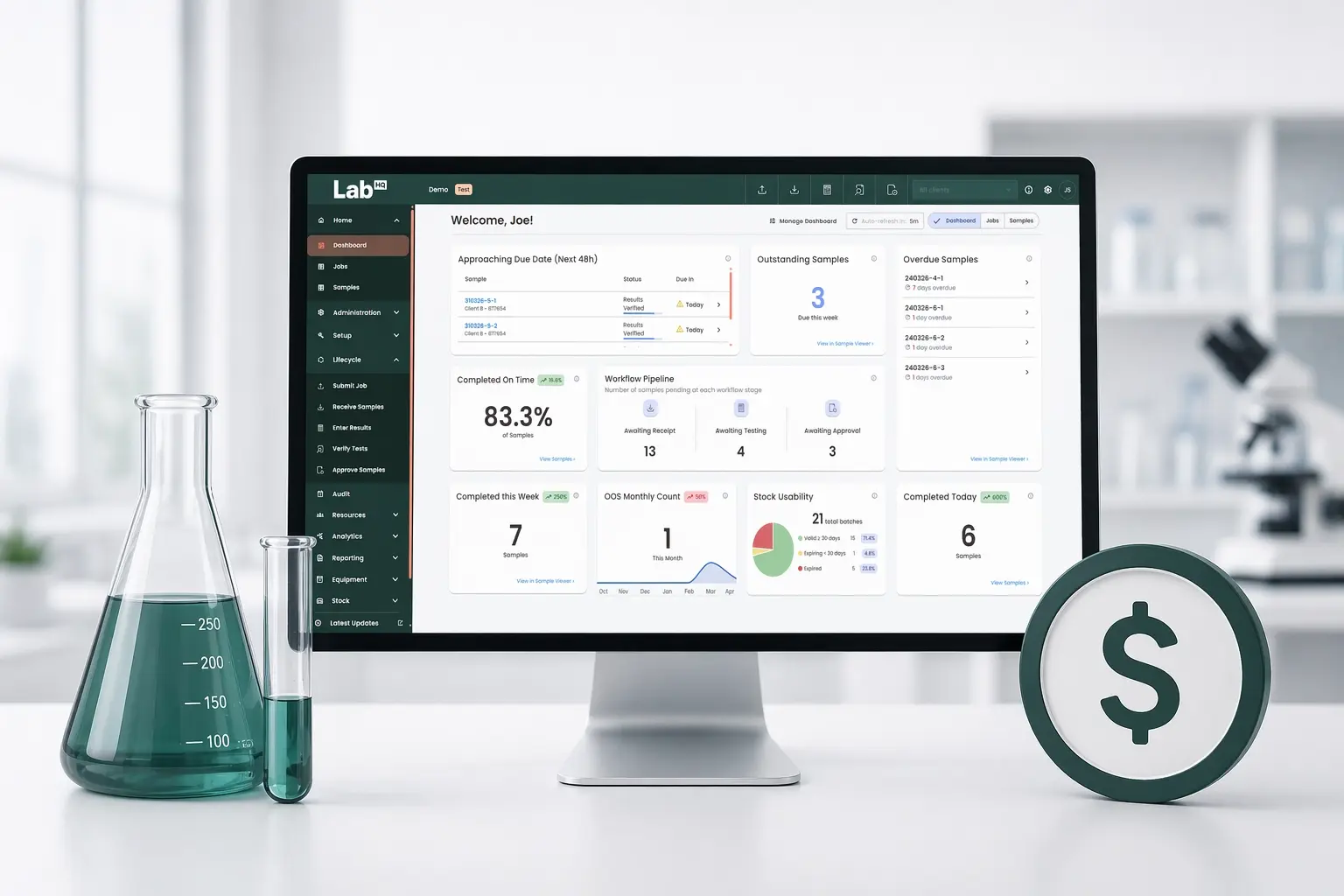
LabHQ is an example at this tier - a modern cloud-based LIMS designed specifically to avoid these additional costs altogether.
LabHQ includes:
- No setup or implementation fees
- No customization charges for workflow changes
- Support, maintenance, and updates all included
For a typical lab with 5 users, costs range from £7,000–£9,000 annually (approximately $9,000–$11,500), with everything included.
Pricing on paid plans:
- Growth plan: £120/user/month on monthly billing, or £100/user/month on an annual subscription (~$125/user/month)
- Advanced plan: £140/user/month on monthly billing, or £120/user/month on an annual subscription
- No setup fees, no implementation charges, no minimum contract length at any plan level
Mid-range pricing ($25,000–$50,000/year)
Mid-range platforms are suited to labs with higher sample volumes or more complex operational requirements - typically labs that need highly configurable workflows, deep instrument integrations via API, multi-client billing, or sophisticated quality management system (QMS) features. These platforms, like lower-priced systems, are often cloud-based, but the level of configurability and implementation effort involved puts them in a different tier.
QBench, a well-known example, says their own average implementation takes 3-4 months - and pricing reflects that complexity. QBench prices across four tiers: Foundation ($275/user/month), Growth ($325/user/month), Advanced ($425/user/month), and Enterprise (custom pricing). With a typical minimum of five users, entry-level QBench starts at around $16,500/year before implementation or training - which QBench prices separately at $5,000–$10,000. Other platforms at this tier include CloudLIMS and Genemod. (ITQlick)
Enterprise pricing ($50,000–$200,000+/year)
Enterprise LIMS are built for large, multi-site global operations - typically pharmaceutical manufacturers, public health labs, or organizations with highly complex regulatory requirements that need extensive system validation, custom scripting, and often on-premise deployment. These systems require dedicated LIMS administrators and significant IT support.
LabWare and STARLIMS are well-known vendors at this tier. LabWare's annual license fees range from $50,000 for 100 users up to $500,000 for global enterprise deployments, and unlike lower-end and mid-range systems, enterprise LIMS are frequently deployed on-premise - adding significant IT infrastructure costs on top. Implementation typically runs 6-18 months with costs often exceeding $100,000 for complex deployments.
Note: LabWare and STARLIMS do not publish their pricing publicly. Figures here come from third-party analysis as of April 2026.
The questions to ask any LIMS vendor
Before signing anything, ask:
- Are there implementation or setup fees?
- What does it cost to change a workflow or report template after go-live? Can I manage this type of change myself or do I need to consult the vendor?
- Is training included or billed separately?
- What is the minimum contract length?
- What does ongoing support cost, and what does it cover?
- What are the data migration costs if we need to move from our current system?
These answers reveal the true cost of a LIMS system far more than the headline price.
It’s also worth remembering that cost isn’t only financial. Overly complex systems can negatively impact team morale and increase workload as staff struggle to navigate software that isn’t suited to how their lab actually works. The right LIMS should make daily tasks easier, not harder.
How to justify the cost of a LIMS to your management
If you’re building a business case internally, focus on three key areas:
- Time saved on manual data entry and report generation. Morris Lubricants, one of Europe’s largest privately-owned lubricant manufacturers, achieved a 75% decrease in data retrieval time and a 50% reduction in transcription errors after switching to LabHQ from manual processes.
- Reduced error rates. Manual COA creation and spreadsheet-based tracking introduce errors that cost far more to correct than a monthly subscription - particularly in regulated industries where a data integrity finding can mean a failed audit.
- Compliance risk reduction. LabHQ is built to support ISO 17025, GMP, GLP, and FDA 21 CFR Part 11 compliance out of the box. Broughton Group - a leading contract testing lab regularly inspected by the FDA and MHRA to GMP standards - uses LabHQ across multiple testing sites.
“Implementing LabHQ has significantly reduced our turnaround times and improved our resource allocation across multiple sites.”
- Director of Laboratory Services, Broughton Group
When building your business case, the return on investment becomes clear quickly: fewer hours lost to manual data entry, fewer errors to chase down, faster turnaround times, and a lab that runs more smoothly day to day. For teams in regulated industries, there's the added confidence of knowing your data is traceable, your audit trails are complete, and compliance isn't something you have to scramble for. A well-chosen LIMS pays for itself not just in cost savings, but in a less stressful, better organized lab.
Explore: Evaluating LIMS Software: Costs and Considerations for Making the Right Choice
What LabHQ costs (transparent pricing)
Labs wanting to streamline their data management in a simple way, can start on LabHQ Essentials – a free subscription tier with- no credit card required, no sales call - so labs can test it with real data before spending anything. Because LabHQ is cloud-based, this setup takes minutes. There’s no infrastructure to procure, no installation process, and no waiting for an implementation team to arrive.
Essentials includes all core LIMS functionality: sample and data management, workflow management, automated reporting and COA generation, and built-in compliance tools. When labs are ready to add equipment management, stock management, or give clients direct access via the external portal, that’s when a paid plan makes sense.
Paid plans start from £100/user/month on an annual subscription, or £120/user/month monthly. There are no setup fees, no mandatory implementation services, and no minimum contract length. LabHQ achieved UKAS accredited ISO 9001:2015 certification in 2016 and has been trusted by labs across regulated and non-regulated industries since 2012.
LabHQ is built for QA and QC labs - contract testing labs, manufacturing quality labs - that need to get compliant, get organized, and get started without a six-month procurement process. If you’re a global pharmaceutical company needing multi-site ERP integration and custom scripting, we’re probably not the right fit - and we’d rather tell you that upfront.
Want to see exactly what your lab would pay?
Start a free LabHQ Essentials account in minutes - no credit card, no sales call, no commitment - and try it with your own lab data. Or book a demo if you'd prefer a guided walkthrough first.